


🗯 About the Project
Machine learning models often appear objective, but they can learn biased or misleading patterns from their training data. In visual classification tasks, this can become especially problematic when models rely on irrelevant visual cues, such as background objects, clothing, or context, instead of focusing on the actual subject.
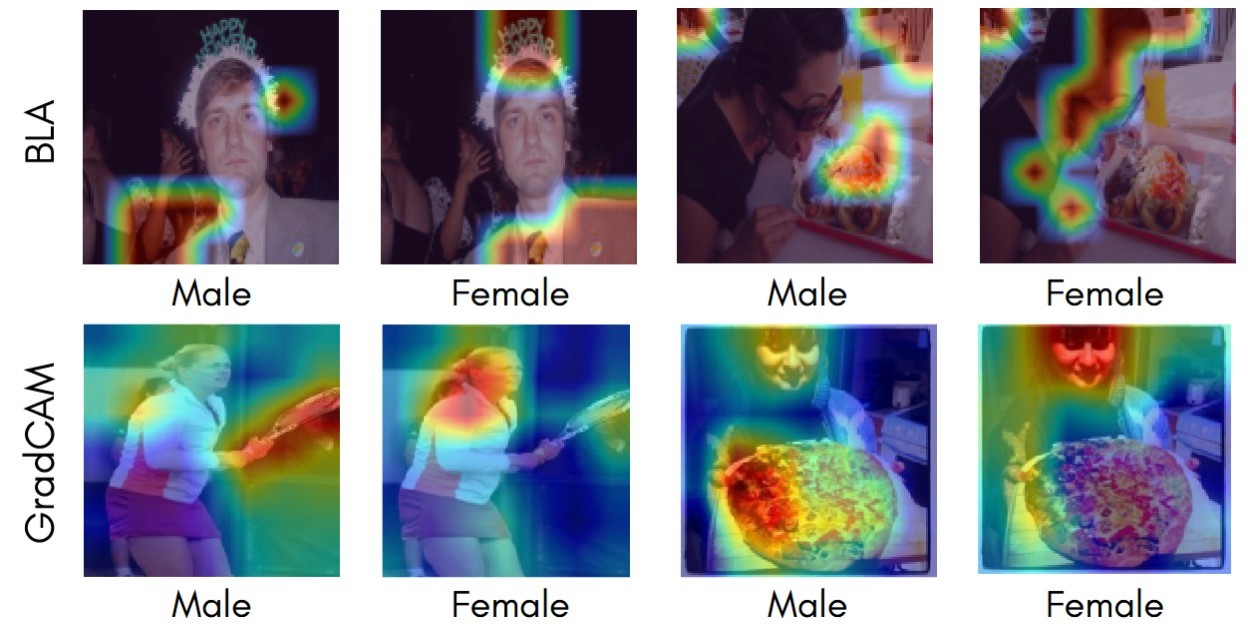
This project investigated how Explanatory Interactive Learning (XIL) can help detect and mitigate bias in visual gender classification. XIL combines interactive machine learning with explainable AI by allowing users to not only correct a model’s prediction, but also guide the model by giving feedback on its explanations.
The main research question was whether explanation-based feedback can guide image classifiers to focus on more relevant regions and reduce biased decision-making. To investigate this, we compared two Explanatory Interactive Learning strategies, CAIPI and Right for the Right Reasons (RRR), and proposed a hybrid approach combining both methods.
🙌 Tasks & Results
Bias mitigation in visual gender classification:
The project evaluated whether XIL methods can reduce gender-related bias in image classifiers by steering the model away from irrelevant background regions and toward the person in the image.
Comparison of XIL strategies:
We compared CAIPI, RRR, and a hybrid CAIPI + RRR approach. The results showed that CAIPI and the hybrid approach were particularly effective in guiding the model to focus on more relevant foreground regions.
Explainability-based evaluation:
Model explanations were evaluated using GradCAM and Bounded Logit Attention (BLA). These explanation methods helped assess whether the classifier was making decisions based on meaningful visual regions or relying on spurious correlations.
Fairness and performance analysis:
The experiments showed that XIL can improve fairness by balancing misclassification rates between male and female predictions. While improved transparency and fairness often came with a small decrease in classification accuracy, one CAIPI setting slightly improved the baseline accuracy from 74.58% to 75.42%.
Overall, the results support the potential of Explanatory Interactive Learning as a promising approach for building more transparent and fair computer vision models.
Read more about the paper here: https://ieeexplore.ieee.org/document/11339339
The code and dataset are available online via: https://github.com/fhstp/xil-gender-classification
✨ Team
Nathanya Queby Satriani
Djordje Slijepčević
Markus Schedl
Matthias Zeppelzauer