

🧠 About the Project
The human visual system is a hierarchical system that feeds forward visual information from lower to higher cortical areas for sequential visual processing. As the third cortical area in the ventral stream (the pathway responsible for item recognition), V4 is known to play a crucial role in detecting shapes of common objects (Wei, H., Dong, Z., & Wang, L., 2018).
Previous models that are able to decode visual input from early visual regions' neural patterns (V1,V2,V3) have been effectively developed even for complex stimuli such as natural images. However, whether a model reproducing the behaviour of V4 would be able to accomplish the same goal is unknown.
Consequently, we hypothesised that it would be possible to model the shape-extracting abilities of V4 and therefore predict its neural activity in response to natural images.
🎯 Methods
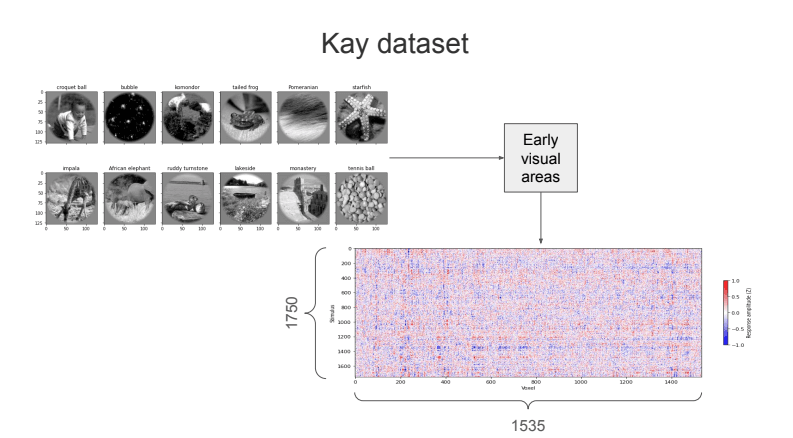
To investigate this hypothesis, we generated and combined Gabor filters with different orientations in order to deconstruct the images' overall shapes into the main orientations of their edges.
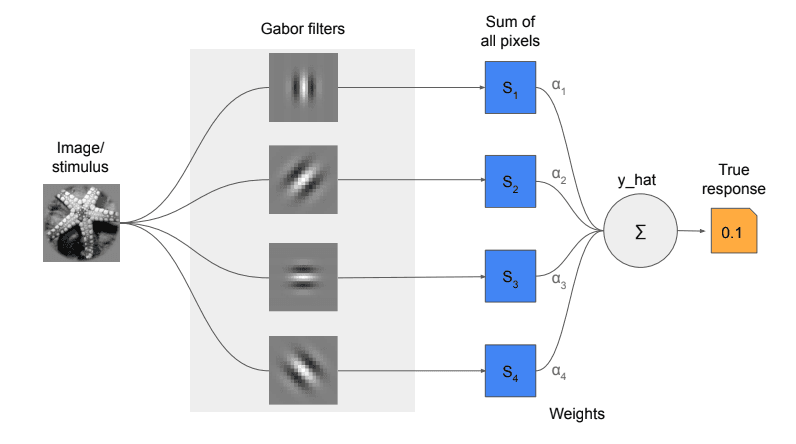
We further fed these features to regression models to relate them with V4 fMRI BOLD responses.
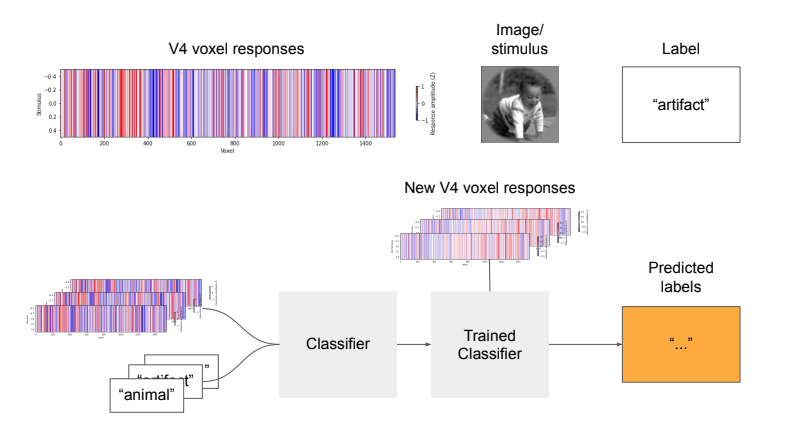
🙌 Results & Final Presentation
Check out the slides for our final presentation here.
✨ Team
Francesca Giaiotti
Nathanya Queby Satriani
Chiah Li Ong
Amir Hosein Asaadi
Đinh Minh Hải